IT, Business & Entrepreneurship: How IT Students Can Become the Next Billionaires
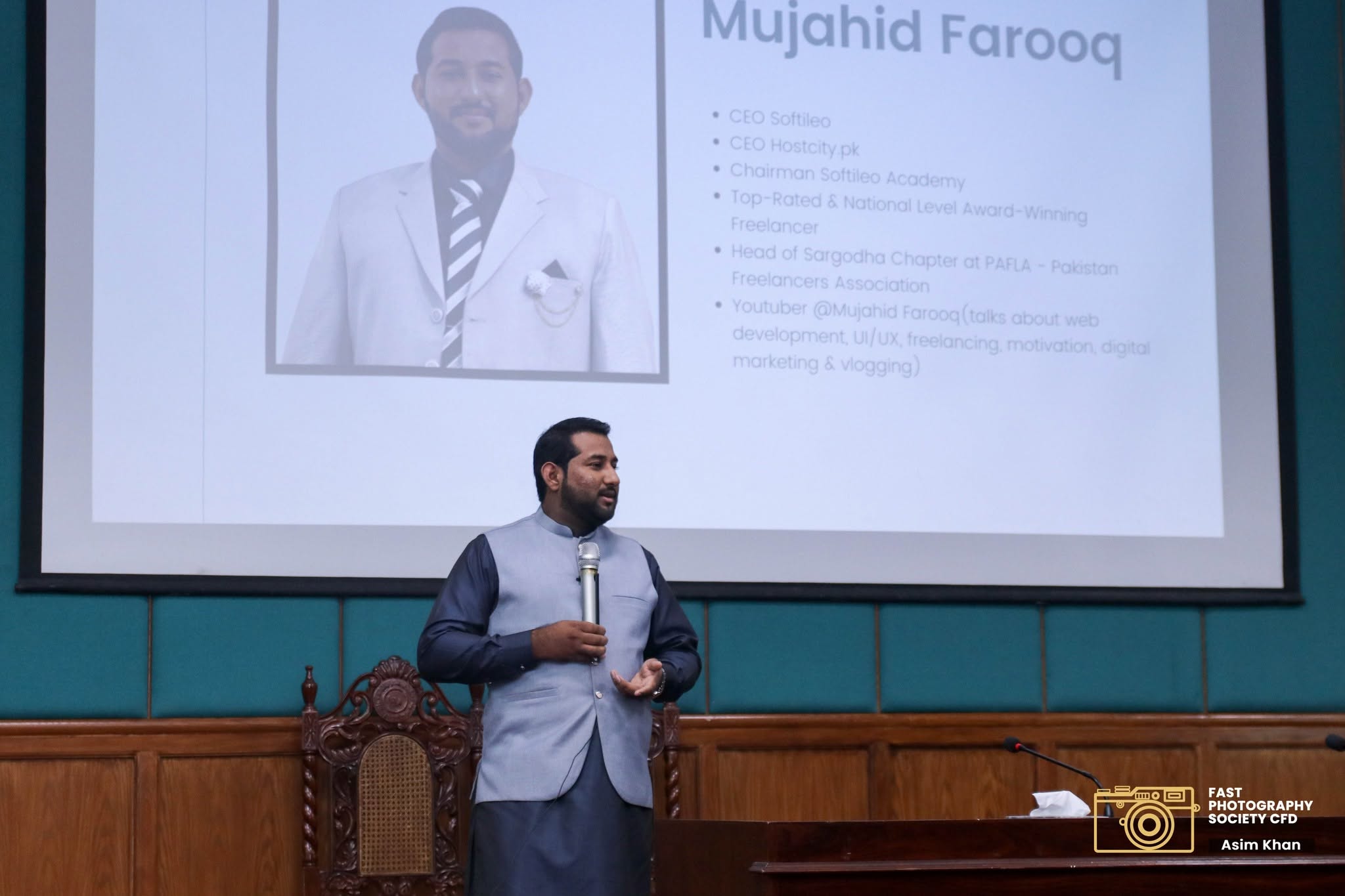
Workshop by Mujahid Farooq, CEO Softileo & FLCS – Freelancers Community Sargodha
FAST NUCES Faisalabad, Pakistan
The technology industry is creating a new generation of entrepreneurs who are building global businesses from laptops, small teams, and innovative ideas. For IT, Computer Science, and Software Engineering students, the opportunity is no longer limited to getting a job after graduation.
The real opportunity is to learn a skill, enter the global market, build a client base, create a team, develop products, and eventually build a technology company.
With this vision, Mujahid Farooq, CEO of Softileo and FLCS – Freelancers Community Sargodha, conducted a workshop at FAST NUCES Faisalabad, Pakistan, titled:
“IT, Business & Entrepreneurship – How IT Students Can Become the Next Billionaires”
The workshop was attended by students from the final semesters of BS Information Technology (BS IT), BS Computer Science (BS CS), and BS Software Engineering (BS SE) programs.
The session focused on a practical question:
How can an IT student move from learning technical skills to earning globally, building an agency, creating products, and becoming a technology entrepreneur?
From IT Student to Global Entrepreneur
Mujahid Farooq shared a practical roadmap based on his own journey in technology, freelancing, software development, agency building, and entrepreneurship.
According to the roadmap discussed during the workshop, students should not think of freelancing as the final destination.
Instead, freelancing can be the first step of a much bigger entrepreneurial journey.
The journey can look like this:
IT Student → Skilled Freelancer → Global Freelancer → Agency Owner → Business Owner → Product Builder → Technology Entrepreneur
This approach allows students to gradually move from selling their individual time and skills toward building systems, teams, intellectual property, software products, and scalable businesses.
Step 1: Learn a High-Value IT Skill
The first step is becoming genuinely good at something.
Students studying IT, Computer Science, or Software Engineering already have an advantage because they are learning the fundamentals required to build technology.
However, academic knowledge alone is not always enough to compete in the global market.
Students need to develop practical skills such as:
- Web and software development
- PHP and Laravel
- JavaScript and modern frontend technologies
- React and API development
- WordPress and Shopify
- SaaS application development
- CRM and ERP development
- AI integrations and automation
- Database management
- Cloud and server administration
- DevOps
- UI/UX and product development
- Digital marketing and SEO
Mujahid emphasized that students should combine their university education with real-world projects, client work, problem solving, and continuous learning.
Step 2: Start Freelancing
Once a student has a marketable skill, the next step is to enter the global freelancing market.
Platforms such as Fiverr, Upwork and other freelancing marketplaces can provide students with an opportunity to work with international clients while still studying.
Freelancing teaches lessons that classrooms often cannot fully replicate:
- How to communicate with clients
- How to understand business requirements
- How to price services
- How to negotiate
- How to meet deadlines
- How to handle revisions
- How to solve real business problems
- How to build a professional reputation
- How to work with international customers
For an IT student, the first freelancing project may not generate a huge amount of money.
But its real value is much greater.
The first client teaches you how the global market works.
Step 3: Stop Selling Only Your Own Time
A freelancer eventually reaches a limitation: there are only so many hours in a day.
If a freelancer personally handles every project, every client, every support request and every technical task, income remains strongly connected to personal working hours.
This is where the next stage begins.
Build a Team.
Mujahid encouraged students to think beyond becoming highly paid individual freelancers.
Once a freelancer has a consistent flow of projects, they can start collaborating with other developers, designers, marketers, project managers, and specialists.
This can gradually transform an individual freelancer into an agency owner.
Instead of saying:
“I can build your website.”
The entrepreneur can eventually say:
“My team can build and manage your complete digital solution.”
That shift is fundamental to building a scalable technology business.
Step 4: Build a Software Agency
An agency provides another major advantage: capacity.
A freelancer may be able to manage a few projects simultaneously.
An organized software agency can manage multiple clients, projects, technologies, and markets simultaneously through specialized teams and processes.
At this stage, students need to learn more than programming.
They need to understand:
- Sales
- Business development
- Lead generation
- Project management
- Hiring
- Team management
- Client retention
- Financial management
- Marketing
- Branding
- Operations
- Business systems
This is the point where an IT professional starts becoming a businessperson.
Step 5: Get More Clients — But Think Beyond Freelancing Platforms
Freelancing platforms can be an excellent starting point, but entrepreneurs should eventually build their own channels for acquiring clients.
Mujahid discussed the importance of developing:
- Personal branding
- LinkedIn presence
- Professional websites
- Search engine optimization
- Content marketing
- Referrals
- Networking
- Email marketing
- Social media
- Direct outreach
- Business partnerships
The objective is to move from depending entirely on marketplaces toward creating a brand that attracts clients directly.
For technology professionals, personal authority can become a powerful business asset.
A developer who is recognized as an expert in a specific field can generate opportunities through content, speaking, networking, conferences, workshops, and professional communities.
Step 6: Solve Problems Instead of Just Selling Services
The next major transition is from service business to product thinking.
Freelancing teaches students how to execute someone else's requirements.
Entrepreneurship requires a different question:
“What problem can I solve for thousands or millions of people?”
Instead of building one website for one client, an entrepreneur can identify a recurring problem and develop a software product that solves it repeatedly.
This could become:
- A SaaS platform
- An AI-powered application
- A marketplace
- A CRM
- An ERP
- An automation platform
- An e-commerce solution
- A specialized business management system
- An AI agent
- A mobile or web application
The difference is scalability.
A service is generally sold one client at a time.
A software product can potentially be sold to thousands of customers without rebuilding the entire solution for every customer.
AI Has Changed the Entrepreneurial Opportunity
Artificial intelligence and Large Language Models (LLMs) have made this opportunity even more significant.
Today's IT students have access to technologies that previous generations of developers did not have.
With modern AI tools, APIs, LLMs, automation platforms, and cloud infrastructure, a small team can develop sophisticated applications much faster than before.
Students can explore opportunities in:
- AI automation
- AI-powered SaaS
- AI agents
- LLM applications
- Business process automation
- Customer support automation
- AI content systems
- Intelligent search
- AI-powered CRM systems
- Data analysis
- AI integrations
- Custom enterprise software
However, Mujahid emphasized an important distinction:
AI is a tool, not the business itself.
The goal should not simply be to build another AI chatbot.
The goal should be to identify a real problem, understand the customer, and use AI and software engineering to create a valuable solution.
From Local Student to Global Technology Company
One of the most powerful ideas discussed during the workshop was that geography is no longer the same limitation it once was.
A student sitting in Faisalabad, Sargodha, Lahore, Islamabad, Karachi, or any other Pakistani city can potentially work with customers in the United States, United Kingdom, Europe, the Middle East, Australia, and other international markets.
The internet has transformed the traditional relationship between location and opportunity.
A student does not necessarily need to wait for a multinational company to come to their city.
They can build skills, create a portfolio, approach international customers, build a remote team, and eventually create a global technology company from Pakistan.
The Billion-Dollar Mindset
The title of the workshop was deliberately ambitious:
How IT Students Can Become the Next Billionaires.
The objective was not to suggest that becoming a billionaire is easy or guaranteed.
Rather, it was to encourage students to think at a much larger scale.
If a student only thinks:
“How can I get a job?”
their strategy will naturally revolve around employment.
If they think:
“How can I earn my first $100 online?”
they may start freelancing.
If they think:
“How can I build a team that generates $10,000, $100,000 or $1 million?”
they begin thinking like an entrepreneur.
And if they eventually ask:
“What problem can I solve for millions of people?”
they start thinking like a product founder.
That change in mindset can completely change the trajectory of a technology professional.
What IT Students Should Start Doing Today
Mujahid's message to students was practical: don't wait until graduation to start building your career.
Students can begin while they are still at university.
A practical roadmap could be:
Semester 1–2:
Learn programming fundamentals and explore different technology fields.
Semester 3–4:
Choose a specialization and start building real-world projects.
Semester 5–6:
Create a portfolio, start freelancing, and work with real clients.
Semester 7–8:
Build a professional network, increase freelance income, and develop a team.
After Graduation:
Choose between employment, freelancing, agency building, entrepreneurship—or a combination of them.
Long Term:
Identify a large problem, develop a scalable product, build a company, and expand globally.
The exact timeline will be different for every student, but the underlying principle remains the same:
Learn → Build → Sell → Scale → Innovate.
Mujahid Farooq's Message to the Next Generation
As the CEO of Softileo and FLCS – Freelancers Community Sargodha, Mujahid Farooq has worked across software development, freelancing, digital business, AI automation, web applications, e-commerce, server administration, and technology entrepreneurship.
His work with freelancers and technology professionals has also given him the opportunity to interact with students, developers, freelancers, entrepreneurs, and businesses across Pakistan.
Through workshops and technology events, his focus is not simply on teaching students how to code.
The bigger objective is to help them understand how technology skills can become economic opportunities.
The FAST NUCES Faisalabad workshop was another step toward that mission.
The Future Belongs to Builders
Pakistan has millions of young people entering technology-related fields.
The next generation of IT professionals has the opportunity to become much more than employees or individual freelancers.
They can become:
Developers.
Freelancers.
Agency owners.
Product builders.
Startup founders.
Technology entrepreneurs.
Global business leaders.
The journey may start with a laptop and a single client.
It may then grow into a team.
The team may become an agency.
The agency may generate the insight and resources required to build a product.
And that product could eventually become a global company.
That is the entrepreneurial journey Mujahid Farooq wanted students at FAST NUCES Faisalabad to think about.
From Code to Clients.
From Clients to Teams.
From Teams to Companies.
From Companies to Products.
From Products to Global Impact.
The next billion-dollar technology company can start with an IT student sitting in a Pakistani university.
And that student could be in the room today.